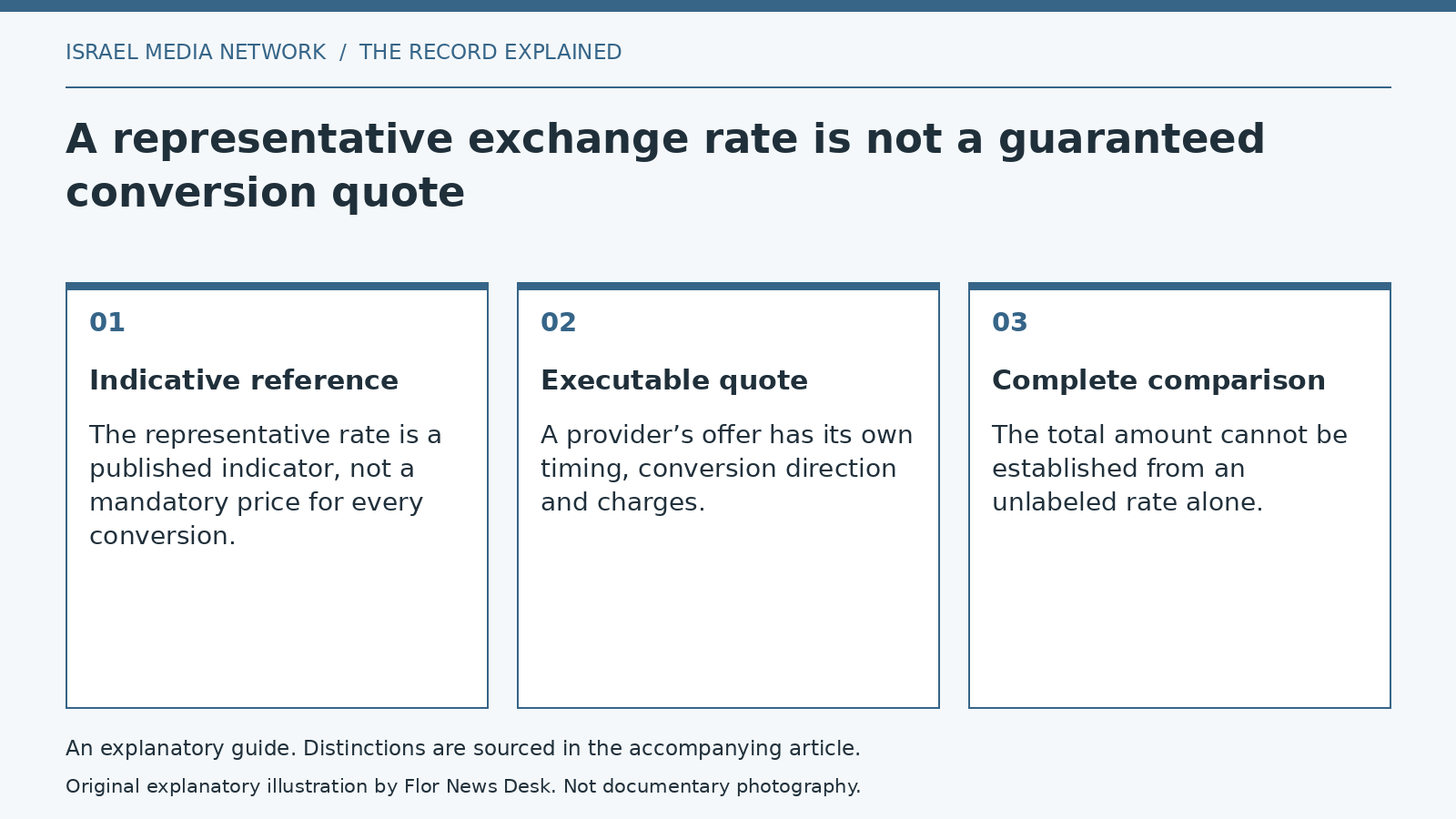

The Bank of Israel describes its representative exchange rate as an indicative reference rather than a mandatory rate for every transaction. Its exchange-rate page notes that parties may agree on a rate or a method of determining one. The published reference is therefore not, by itself, an offer to convert a customer’s money.
That difference can be lost when two numbers appear next to the same currency symbol. An indicative market measure and a provider’s executable quote may concern different times, buying or selling directions and included charges. A comparison that omits those labels cannot establish the total conversion cost.
A simplified example
Suppose a fictional reference is 3 units of local currency for one unit of foreign currency. A fictional provider offers 3.1 units and a separate fixed charge. Multiplying an amount by the reference would describe one calculation; multiplying it by the offered rate and adding the charge would describe another. These invented figures are not current exchange rates or offers from a real bank.
The direction also matters. A statement of local currency per foreign unit is the inverse of foreign currency per local unit. Reading the same digits as both quantities would be a calculation error, not evidence that a provider changed its price.
The bank’s explanatory notes describe the reference as an indicator based on market quotations, not necessarily on completed transactions. Those notes provide methodological context. They do not establish a particular customer’s agreed conversion terms.
Match the timestamp and the purpose
An observation made at one time should not be used to describe a quote made later without acknowledging the difference. A reference used for a statistical comparison can also serve a different purpose from a conversion rate specified in an agreement. The intended use of the number is part of the record.
For example, two fictional providers might quote the same numerical rate while treating fees differently. Ranking their offers from the rate alone would leave the total amount unresolved. Conversely, different quoted rates would not by themselves establish a difference in total cost when other charges differ.
The public reference is useful precisely because it has a defined role. Treating it as a universal retail quote would give it a role the bank does not claim. This explanation is about interpreting rate information, not a recommendation to exchange currency, select a provider or time a transaction.