For Gaza and the West Bank, the most important point in the UN’s 24 September 2026 appeal to donors is not simply that needs are severe. It is that the Office of the United Nations Special Coordinator for the Middle East Peace Process argued that the aid system itself needs to be simplified, with recovery aligned behind a unified national Palestinian plan and a consolidated approach to financing and accountability, because early recovery in Gaza remains well below the required scale while the Palestinian Authority faces what UNSCO called an acute fiscal and institutional crisis. UNSCO report UNSCO press release
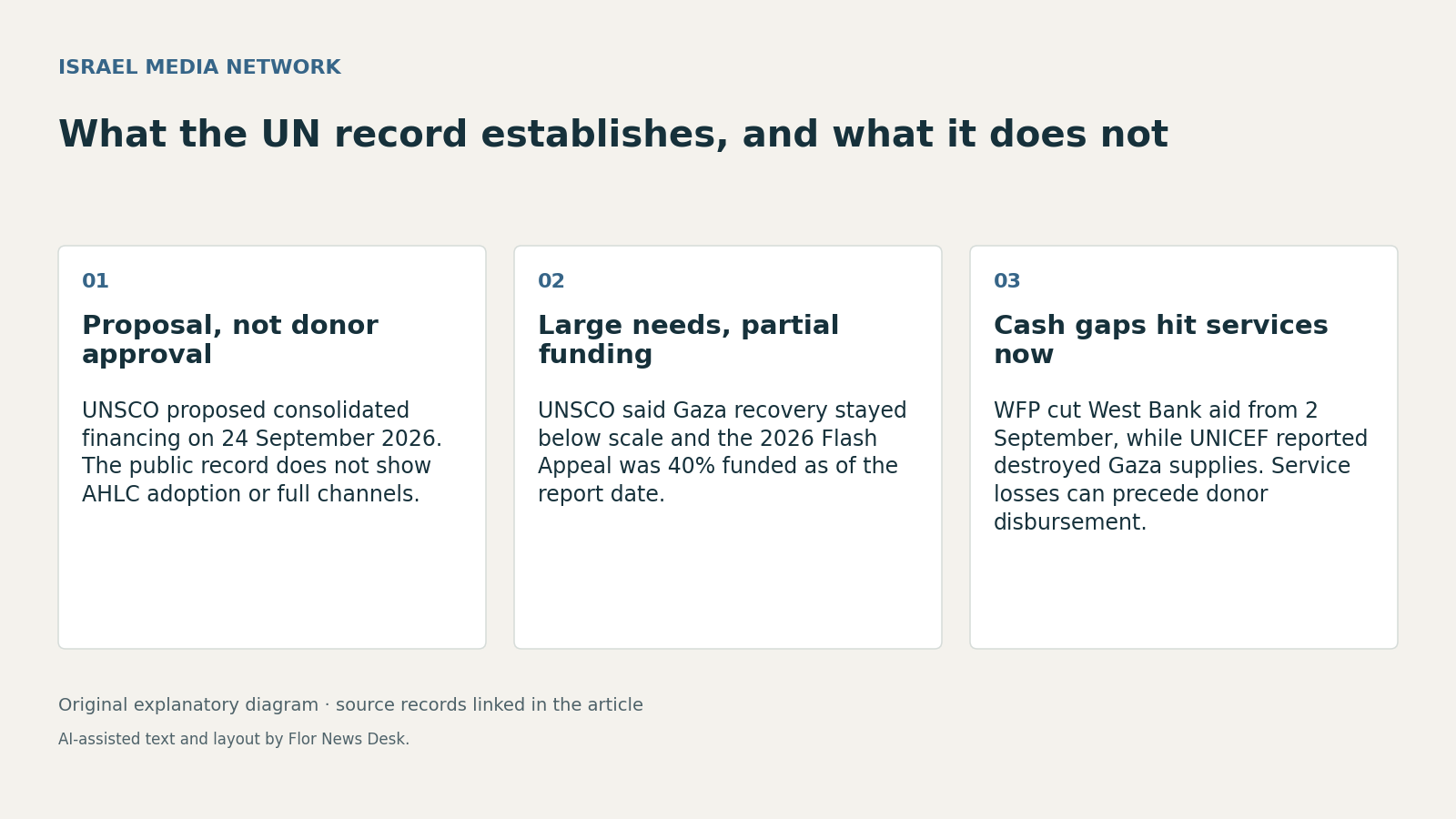
That matters because the public record shows a coordination proposal, not a donor decision. The press release identifies the Ad Hoc Liaison Committee as the principal policy-level mechanism for development assistance to the Occupied Palestinian Territory, chaired by Norway and co-sponsored by the European Union and the United States, with participation from the UN, World Bank and IMF. But the same record does not show AHLC endorsement of a new framework, does not name implementing channels for all donors, and does not document disbursements under any consolidated mechanism. UNSCO press release
UNSCO’s case for urgency rests on both scale and failure to convert existing initiatives into visible early recovery. The report says the 2026 Flash Appeal was 40 per cent funded as of 24 September 2026, while the Rapid Damage and Needs Assessment published on 20 April 2026 estimated Gaza recovery needs at $71.4 billion over 10 years, including $26.3 billion in the first 18 months. It also says the UN Horizon Fund, the EU Team Gaza Initiative and the World Bank’s Palestinian Fund for Reconstruction and Development had not yet translated into early recovery at scale. That is a stronger point than a generic funding plea: institutions and vehicles exist, but the report says their effect on the ground is still limited. UNSCO report World Bank statement
Early-September UN briefings help explain why delay carries immediate service costs, even though they do not prove any solution will work. On 1 September 2026, a UN page citing OCHA, UNICEF and WHO said damage to a partner warehouse destroyed more than $770,000 in nutrition supplies intended for more than 45,000 children, pregnant women and breastfeeding mothers, and that a nearby strike severely damaged a UNICEF-supported water well and desalination facility in Deir al Balah serving more than 4,000 people. The same update said authorization to bring in equipment and remove explosive ordnance had still not been granted. Those facts point to a recovery problem that is financial and operational at the same time. UN incident briefing
The West Bank side of the UN warning is less about reconstruction than institutional stability. UNSCO says Israel continued to withhold about $6 billion in clearance revenues and cites a World Bank assessment that the Palestinian Authority fiscal deficit was above 10 per cent of GDP; it also says the UN had documented more than 1,430 incidents involving Israeli settlers in 2026 affecting about 260 Palestinian communities, with about 3,800 Palestinians displaced in 2026 because of settler violence, demolitions and evictions. In July, World Bank Managing Director Anna Bjerde separately said the PA faced a severe fiscal crisis, welcomed a six-month extension of correspondent banking relations, and argued that resolving clearance revenues and raising the cash repatriation quota were essential. UNSCO report World Bank statement
A separate 2 September UN briefing shows why donors need to distinguish pledges from usable money. It said World Food Programme funding shortfalls had forced the agency to cut West Bank assistance by half, with about 200,000 people losing access to critical assistance from 2 September 2026, while WFP had already reduced cash assistance to 75,000 families in Gaza in July and needed $386 million to avoid further reductions over the next six months. UN food-aid briefing The analytical takeaway is narrow but important: the UN’s 24 September package describes a governance fix for fragmented aid, yet the available public documents still do not establish which donor promises have become disbursed funds, through which channels, or with what measured recovery output. Until that chain is public, readers should treat the framework as an urgent proposal rather than an implemented turning point.