
The OECD’s 2025 Economic Survey of Israel discusses long-term productivity alongside education, infrastructure and participation in the labour market. Its recommendations address the conditions under which people and firms can contribute to economic activity, rather than treating one quarterly growth figure as a complete account of economic capacity.
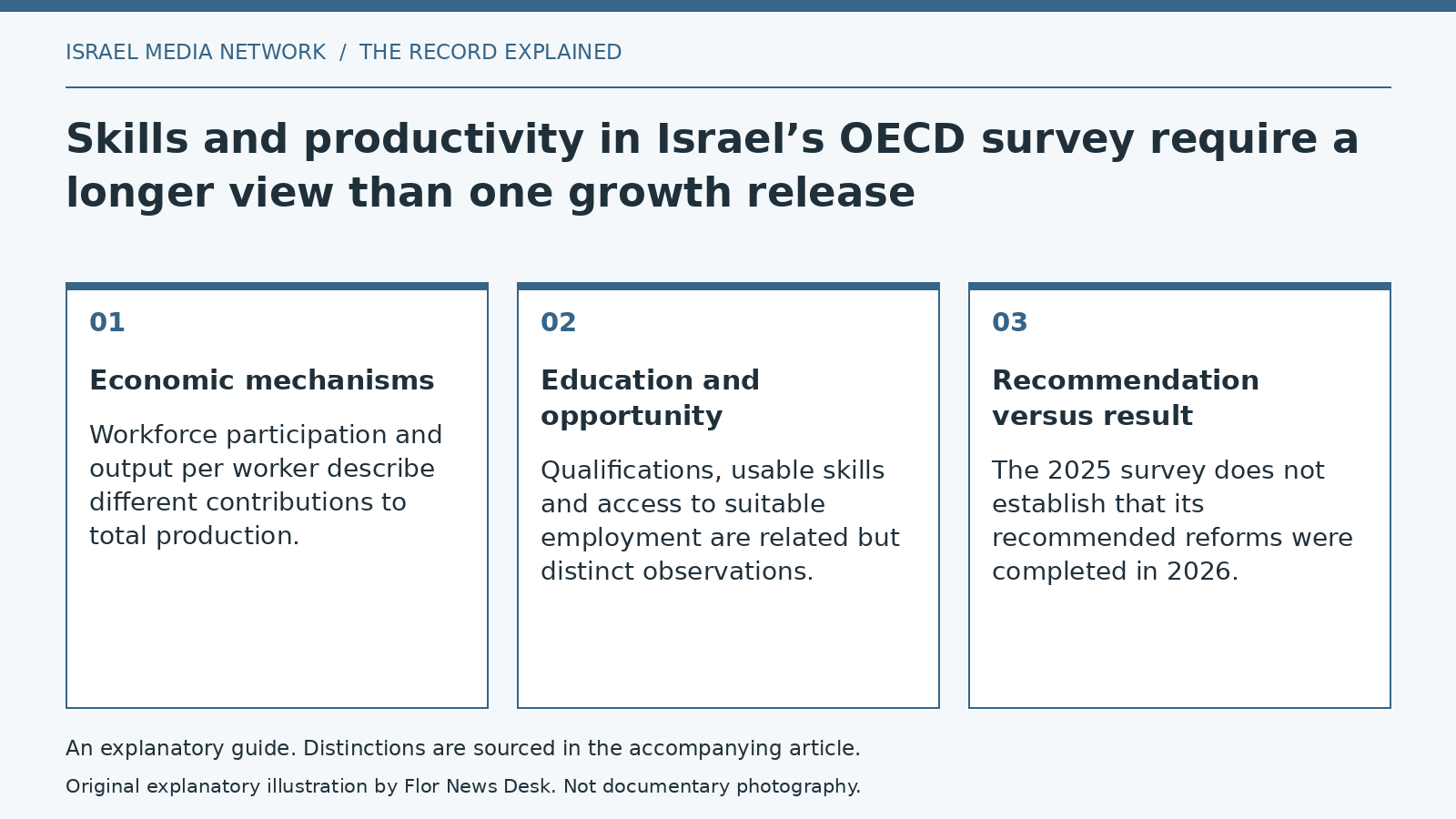
The report is a 2025 assessment. Its availability in September 2026 does not make it a new survey or establish that recommended changes have since been implemented. The difference between diagnosis, recommendation and observed reform matters when using the document as context for current economic reporting.
More workers and more output per worker
A hypothetical workplace illustrates two separate sources of change. It could produce more because additional people start working, or because the existing workforce produces more per hour. Both changes might increase total output, but they describe different mechanisms. A total alone cannot identify their relative contributions.
Education introduces another distinction. Completing a qualification, possessing a particular skill and being able to use it in a suitable job are related but not identical observations. A count of certificates would not establish job access, just as an employment count would not fully describe the tasks performed or the learning involved.
The OECD’s education-outcomes material provides a broader framework for examining the relationship between education and economic or social results. That relationship needs defined measures. A comparison of groups cannot automatically establish that education alone caused every observed difference.
Implementation needs its own record
Suppose a fictional reform announces additional training places. The announcement establishes an intended expansion. Enrolment records would show participation, completion records would show who finished, and later employment observations would address another stage. Calling all these stages a single successful reform would obscure where the evidence ends.
The same care applies to the survey’s infrastructure and labour-market recommendations. A recommendation describes an action the institution considers useful. It is not a construction completion record, a budget execution statement or a measured improvement in access to work.
The survey is therefore useful as a set of longer-term questions to bring to newer evidence. Which constraint was identified? What action was actually taken? What changed, for whom, and over which period? Answering those questions requires records beyond the recommendation itself. The report should not be used to assign a single experience to all Israelis or to imply that a later growth release resolves every structural issue it discusses.