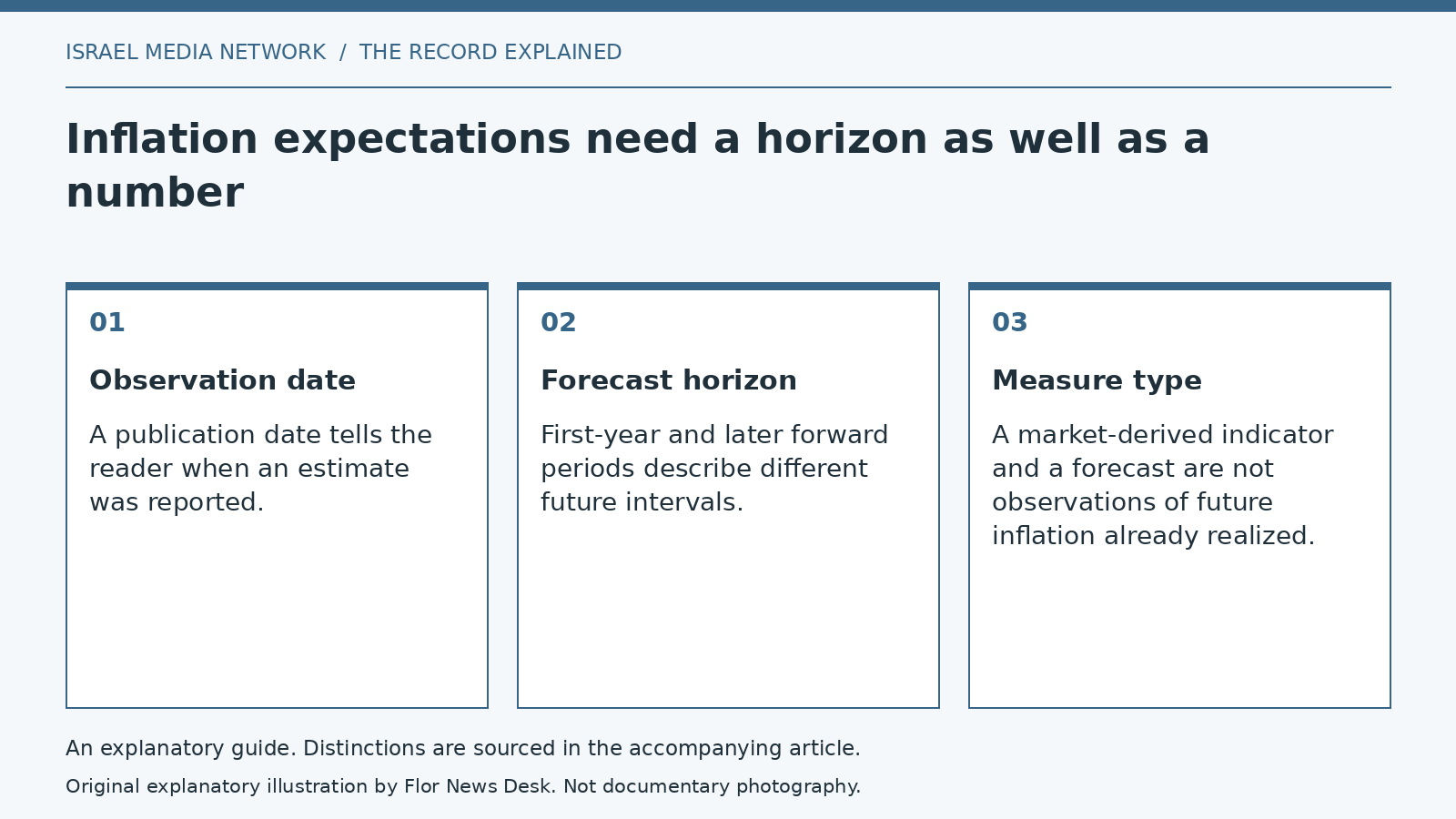

The Bank of Israel’s September 22 inflation-expectations publication presents several ways of looking ahead: capital-market measures, forecasters’ estimates and expectations derived from other financial instruments. Its column labels also distinguish an initial year from forward periods farther into the future.
A number without those labels is incomplete. An expectation for the coming year concerns a different interval from a forward expectation for a later year. Neither is the same thing as observed inflation over the previous twelve months. Putting them on the same line does not make them interchangeable observations.
Read the interval before the difference
Consider an imaginary table with one estimate for next year and another for the following year. A difference between the two could describe the expected path across time. It would not, by itself, show that expectations had risen since yesterday. To describe a revision, the comparison would need estimates for the same horizon observed at different dates.
The reverse problem also arises. Two forecasts published a month apart might each say twelve months ahead. Their windows would then overlap without being identical. A clean account of the change would identify both the observation dates and the future periods covered.
The release explains that its capital-market measure is derived from the relationship between yields on unindexed and CPI-indexed government bonds. This is a market-derived indicator, not a direct count of future price changes. It should be described as such rather than presented as an outcome already measured.
The bank’s monetary-policy framework supplies context for why inflation is relevant to policy. But a table of expectations does not itself announce an interest-rate decision. Evidence about expectations and a committee’s eventual choice remain separate records.
Agreement is not certainty
Several measures pointing in a similar direction would not guarantee that future inflation will match them. Conversely, a gap between columns is not automatically a calculation error. Different sources and time horizons can be answering different questions.
For a reader following the next release, the useful comparison is specific: the same measure, the same horizon and the relevant observation dates, with any methodological change identified. This report does not select a preferred forecast or predict a policy response. It explains why the metadata around an expectation is part of the information, rather than an optional footnote to the headline number.