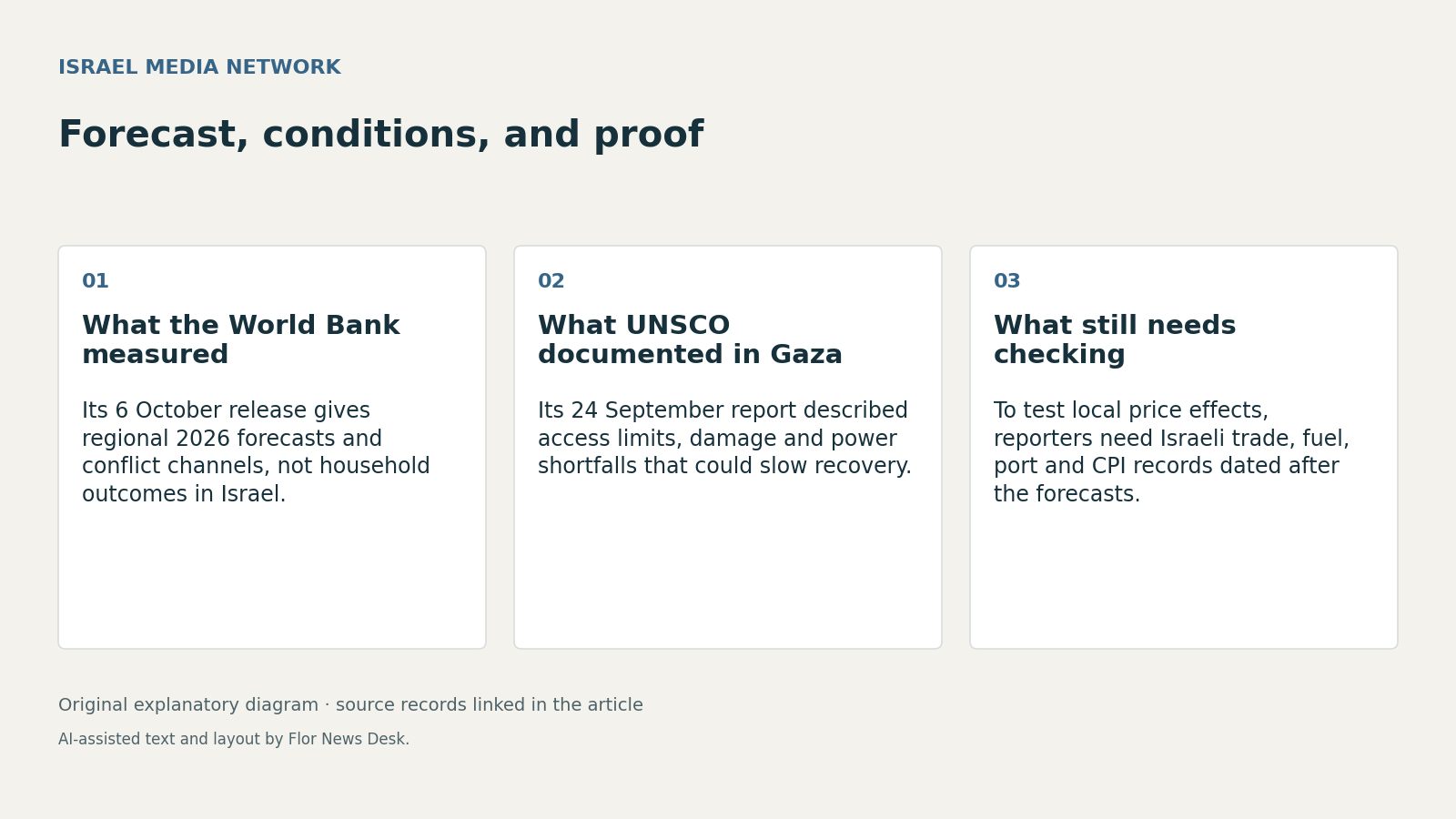
On 6 October 2026, the World Bank said conflict across the Middle East, North Africa, Afghanistan and Pakistan was severe enough to pull the wider region into a 2.1% contraction in 2026 after 3.3% growth in 2025, with Gulf Cooperation Council economies projected to contract by 4.3% on average. The institution linked the heaviest losses among oil exporters to the closure of the Strait of Hormuz and also warned of inflation pressure through shipping disruption, import costs and food prices. Those are documented regional claims, not local outcomes in Israel. World Bank release
For Israel readers, that distinction matters. The World Bank page is a press release summarizing a regional update, not a country-by-country audit of what families or firms have already paid. It supports a specific argument: conflict can raise costs through trade, transport and supply channels. It does not, by itself, identify how much of any later price movement in one economy came from those channels, or when such effects would appear. World Bank release
A second institutional record shows why any recovery story is also conditional on physical access and reconstruction, not only on headline growth assumptions. In its report to the Ad Hoc Liaison Committee, published on 24 September 2026, the Office of the United Nations Special Coordinator for the Middle East Peace Process said the ceasefire that took effect on 10 October 2025 remained fragile, around two-thirds of Gaza was inaccessible or under severe access restrictions, and electricity supply, including the Gaza Power Plant, had not been restored. UNSCO also said the 2026 Flash Appeal was 40% funded at that point. UNSCO report
Read together, the two documents sharpen one useful point. The World Bank’s 2027 rebound figure is explicitly conditional: excluding Iran, regional growth is projected at 7.8% in 2027 only if the conflict subsides by the end of 2026. The UNSCO report, published 12 days earlier, does not establish whether that condition will be met by 18 October 2026. But it does show that even a lower-violence scenario would still face severe access, power and rebuilding constraints in Gaza. World Bank release UNSCO report
That is also where the current source record stops. A regional forecast does not measure Israeli household bills, and a humanitarian situation report does not measure Israeli trade volumes or consumer inflation. To test whether the World Bank’s warning translated into living-cost pressure inside Israel, reporters would still need dated Israeli administrative data that neither source provides: customs and port throughput records, fuel and distillate price series, CPI components, and tax receipts that can help separate price changes from volume changes.
As of 18 October 2026, the evidence supports a narrower conclusion than many political arguments imply. Major institutions are describing the same conflict as both a macroeconomic shock and a continuing obstacle to recovery. What they have not yet shown is the size, timing or distribution of any consumer-level effect in Israel or neighboring economies. That gap is the difference between a forecast, a humanitarian assessment and a measured outcome. World Bank release UNSCO report