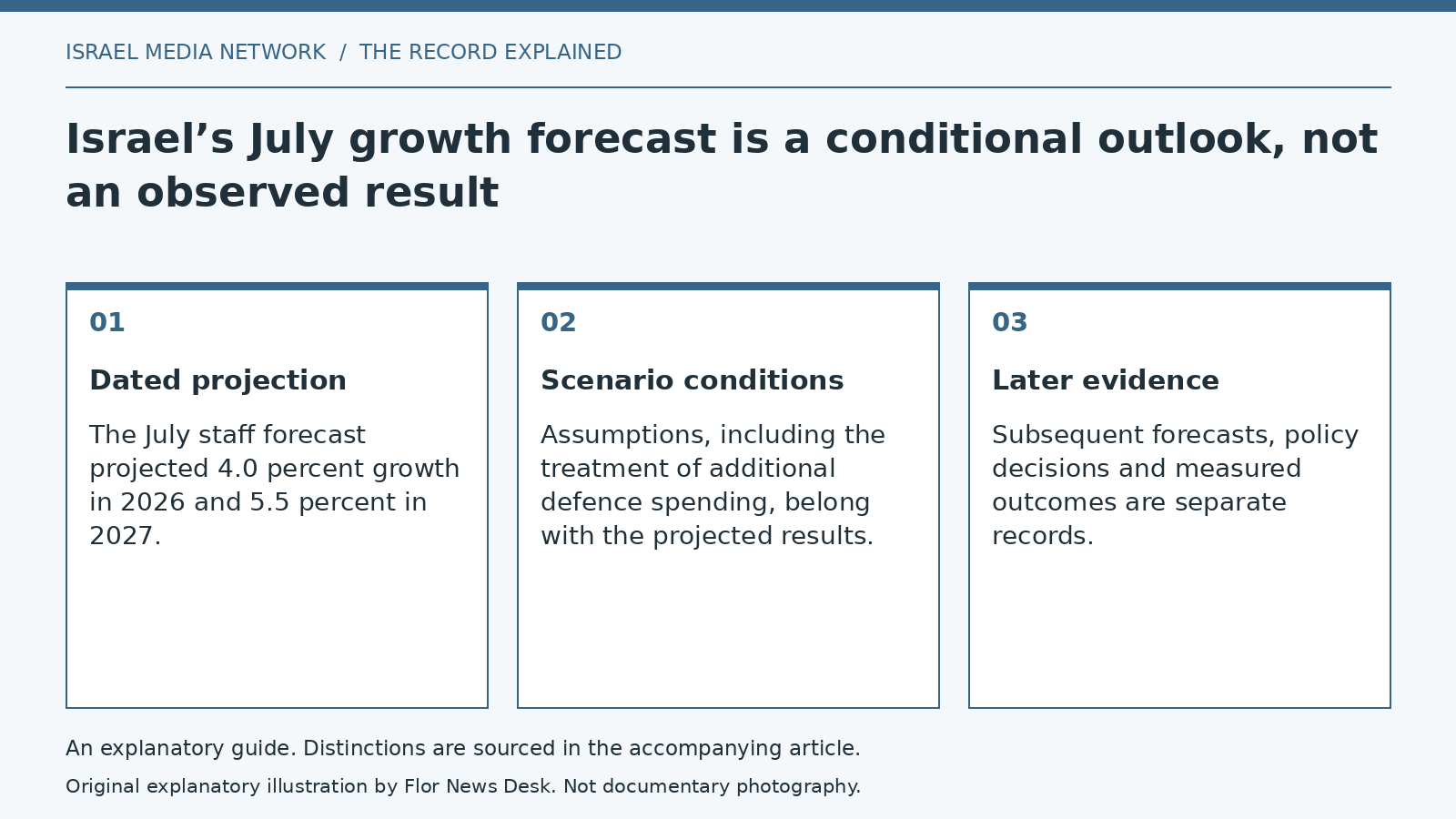
The Bank of Israel’s research department projected economic growth of 4.0 percent in 2026 and 5.5 percent in 2027 in its July 6 staff forecast. These are the department’s dated expectations, not measurements of full-year outcomes already achieved.
The forecast also presents paths for inflation, interest rates and public finances. Those projections belong to an assumed economic setting. Reading one number in isolation can conceal the conditions under which the surrounding outlook was constructed.
Assumptions are part of the forecast
One explicit condition in the public-finance discussion concerns additional defence spending. The outlook ties its fiscal estimates to an assumption about that spending. The conditional wording should remain attached when the figures are reported; it cannot be silently replaced by a claim that the assumed budget path has occurred.
A simple hypothetical comparison shows why. Imagine one forecast built around unchanged spending and another around additional expenditure. A difference between their deficit projections could arise from the different assumptions. It would not necessarily show that the forecasters disagree about the same underlying scenario.
The central bank’s staff-forecast collection identifies forecasts by publication date. That sequence makes revisions possible to examine, but each comparison still needs consistent definitions and reference periods. A forecast for next year made in January does not have the same information set as an assessment published in July.
Growth rates and economic levels
Another distinction concerns a growth rate and the size of the economy. In a fictional series, a high percentage increase after a weak period might coexist with a level below an earlier projected path. The percentage change alone would not establish whether that earlier path had been regained. This is an arithmetic illustration, not a claim about the measured Israeli economy.
The July outlook also cannot determine a later committee decision simply because it includes an interest-rate projection. A staff forecast and a policy decision have different authorship and procedural roles. Subsequent decisions must be established from their own records.
For readers using the July numbers in September, the useful description remains dated and conditional. The release documents what the research department expected on July 6 under its stated assumptions. A later forecast can revise that expectation, while statistical releases can establish outcomes as the relevant periods end. Neither result should be inferred from the earlier forecast alone.