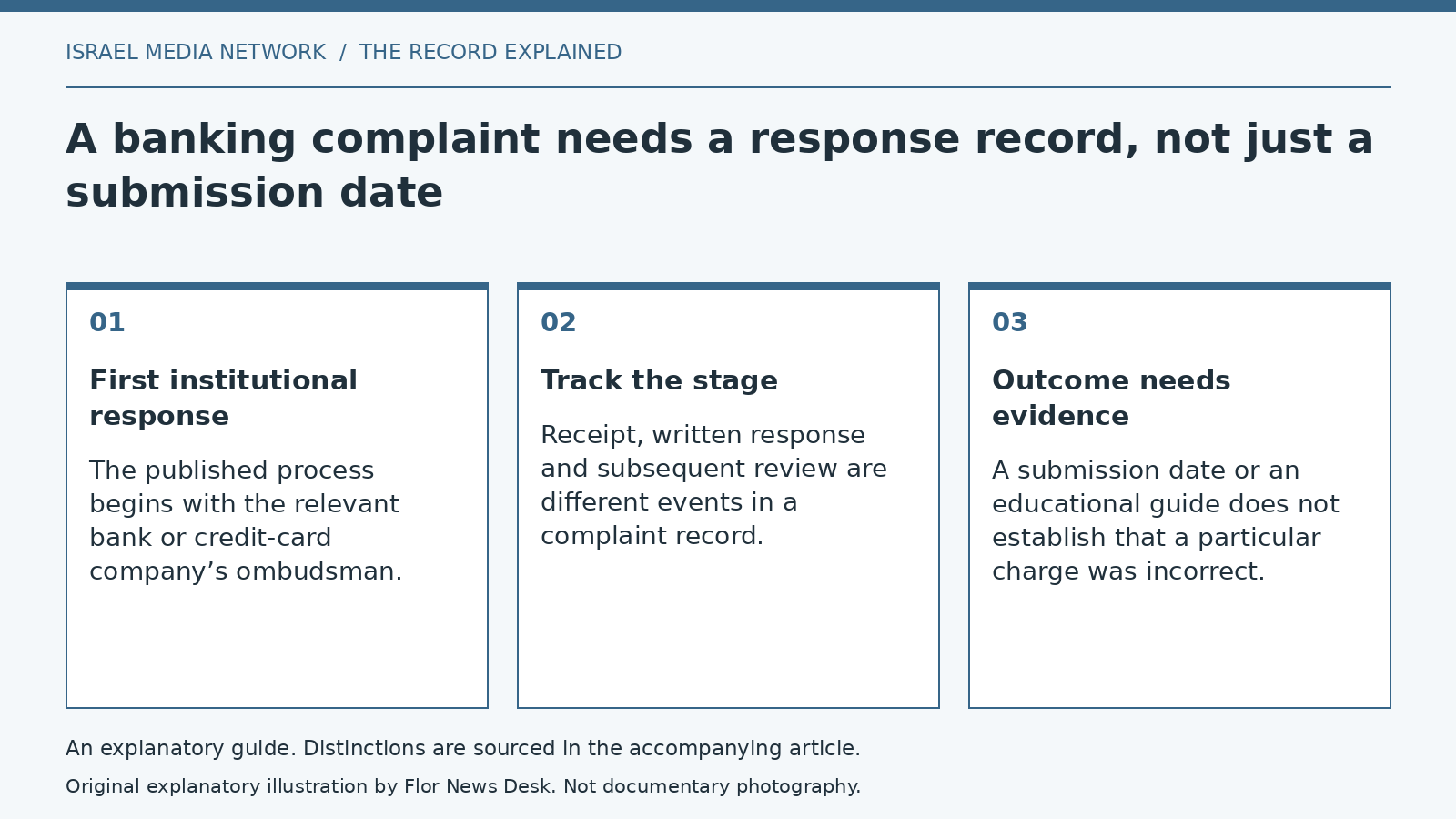

The Bank of Israel’s consumer-enquiries guidance describes a complaints process that begins with the ombudsman of the relevant bank or credit-card company. It states that a written response is generally due within 45 days, with some circumstances allowing 60 days when the complainant receives written notice.
Those time limits describe stages in the published process. They do not establish that every complaint is justified, that a refund will follow, or that the same route covers every disagreement involving money. A reader needs to separate acknowledgement, investigation, response and any further review.
What a timeline can establish
Imagine a fictional complaint submitted on one date and answered on another. A receipt could establish that it was received. The written response could establish the institution’s explanation. Neither record alone would demonstrate whether the underlying account entry was correct; that would require the relevant transaction evidence.
A further distinction concerns a response that is late and a response with which a customer disagrees. Both may matter to the customer, but they are not the same proposition. Evidence supporting one does not automatically resolve the other.
The official page explains how a dissatisfied customer can approach the Banking Supervision Department after the institution’s response, and describes the office’s handling of matters within its remit. This report does not determine whether a specific dispute belongs in that process. The point is to identify the described sequence without promising a result that depends on an individual record.
Information resources do another job
The bank’s financial-education directory links to material on subjects such as account costs, verification and financial fraud. Educational information may help explain terminology. It is not a decision on the merits of a complaint, and the existence of a general guide does not prove what happened in a particular account.
In the fictional case, a clear explanation of a fee category might still leave a factual question about whether that fee was charged according to the relevant terms. Matching the explanation to the dated account records would remain necessary. That is a different task from simply locating an information page.
The published procedure is best read as a route for assembling and examining a record. Submission marks the beginning of that record, not its conclusion. This analysis describes the distinction between process and evidence; it does not advise on a particular claim or predict compensation.