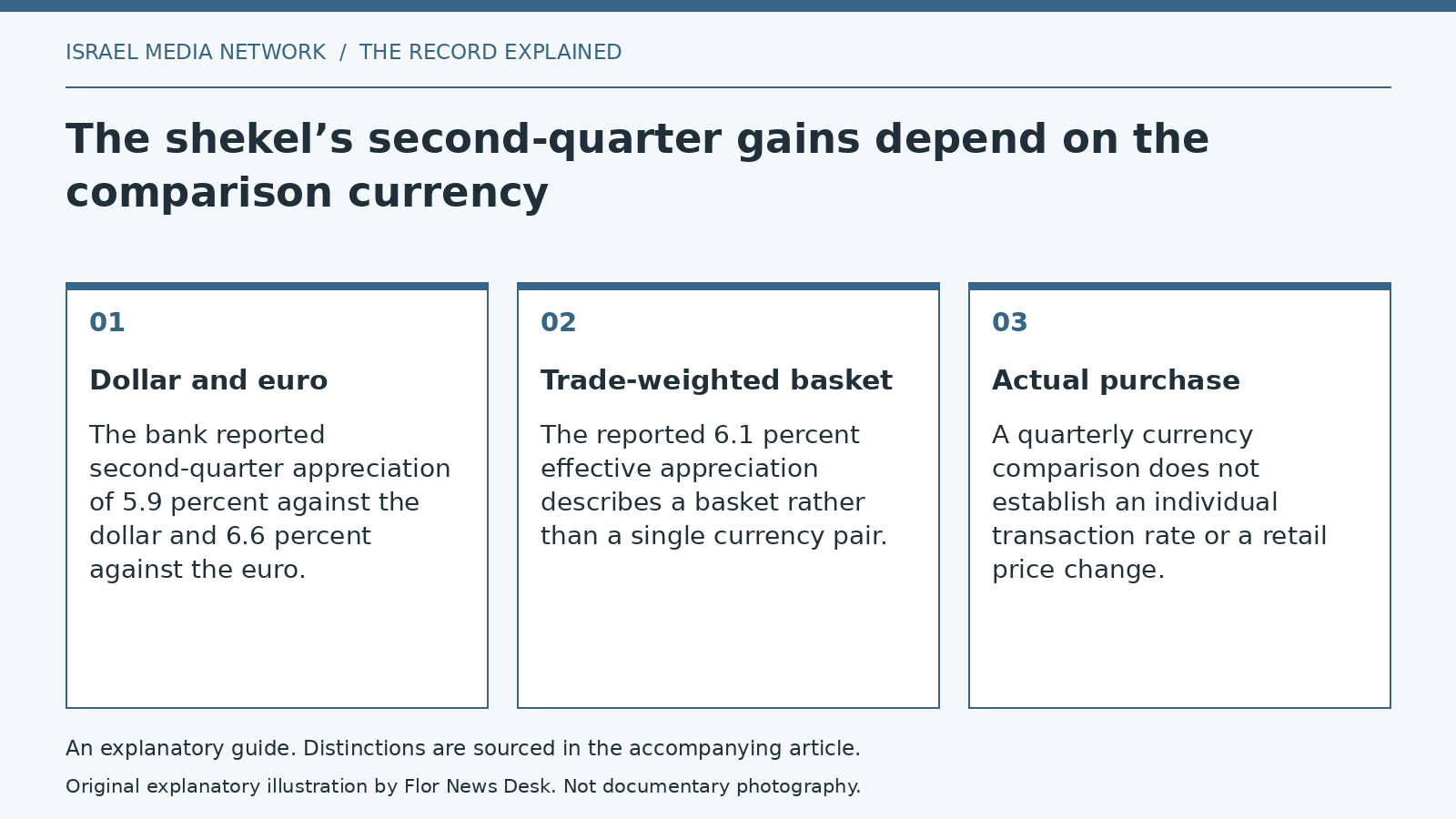

The shekel strengthened by 5.9 percent against the US dollar and 6.6 percent against the euro in the second quarter of 2026, according to the Bank of Israel’s August 2 foreign-currency market report. Against the nominal effective exchange-rate basket, the reported appreciation was 6.1 percent.
These are three comparisons, not competing estimates of one identical quantity. The dollar and euro figures each describe a bilateral relationship. The effective measure combines currencies associated with trading partners. Its result depends on the basket as well as the movements of its components.
One currency, several perspectives
Imagine a simplified economy trading equally with two partners. Its currency could strengthen against one partner’s currency while remaining unchanged against the other. A combined measure would describe that mixture rather than reproduce either bilateral result. This example explains the role of a basket; it is not a reconstruction of the bank’s weighting method.
A business buying an input priced in dollars and another buying an otherwise similar input priced in euros would therefore begin with different exchange-rate comparisons. That observation does not establish their total costs. Contract prices, purchase dates, transport and other charges would still need to be known.
The bank’s exchange-rate information also distinguishes representative rates from rates agreed in actual transactions. An official statistical reference is not a universal promise about the conversion offered by every provider. That difference matters before translating a market movement into a particular commercial invoice.
A quarter is not every transaction inside it
The report concerns the second quarter. An August publication date does not turn it into an August-only observation, and it supplies no complete record of September trading. Two firms making purchases on different dates within the quarter could encounter different rates even when the quarter’s overall direction was the same.
There is a further distinction between exchange-rate movement and the price paid by a final customer. A currency comparison alone does not show whether a supplier changed its selling price, or when an existing stock of goods was purchased. Those links need evidence rather than an assumed one-for-one adjustment.
The useful question is consequently not just whether the shekel rose. It is which benchmark, which period and which transaction are being described. Keeping those labels attached preserves what the second-quarter figures actually measure without turning them into a forecast or a claim about every household’s purchasing power.