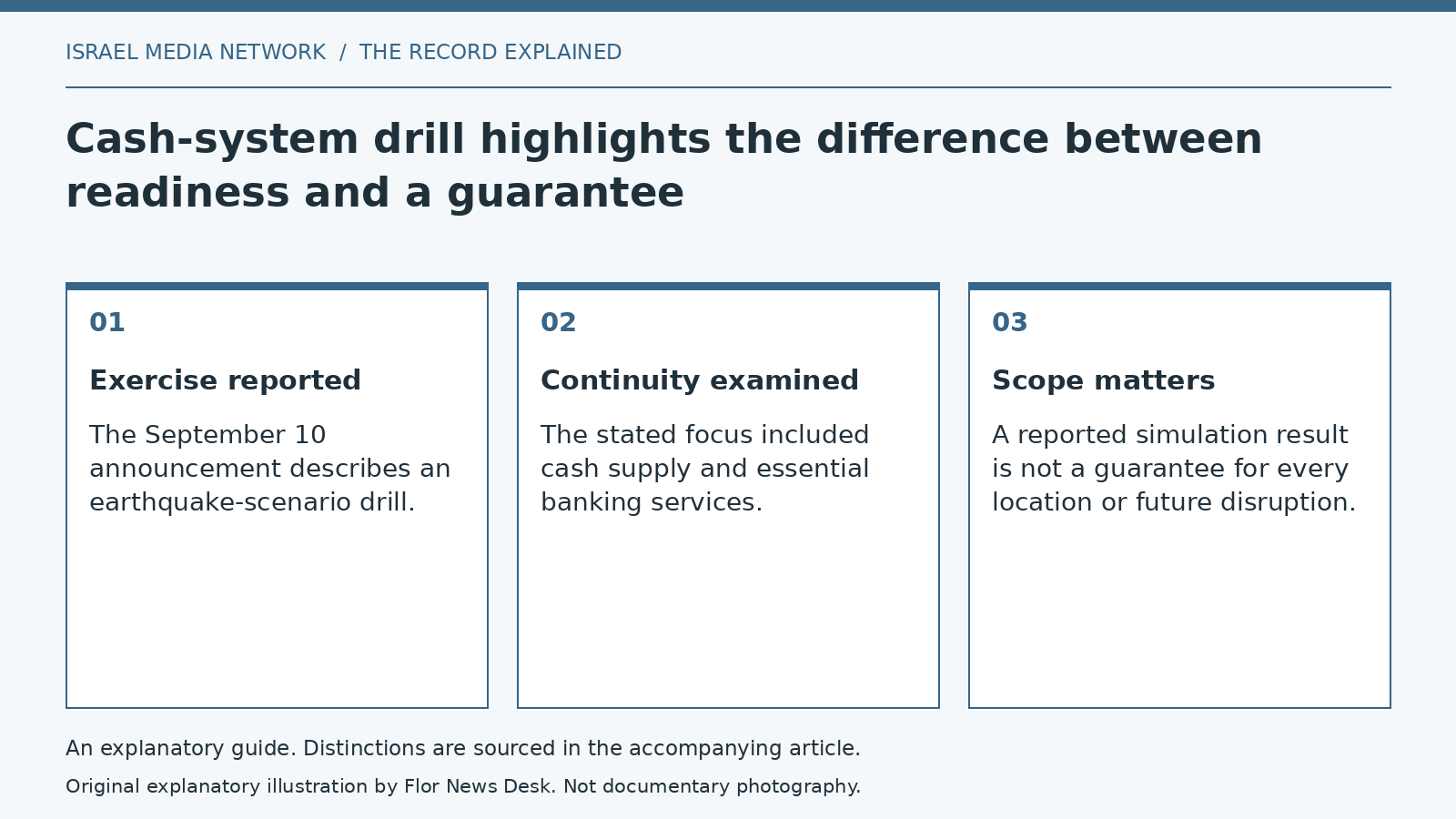
The Bank of Israel announced on September 10 that it had held a national exercise examining the currency system’s preparedness for an earthquake scenario. The bank’s account says the exercise covered continuity of cash supply and essential banking services, and describes a high level of participant preparedness.
That is an attributed assessment of a simulated scenario. The short public account does not publish a complete set of test conditions, a service-by-service scorecard or evidence about an actual future earthquake. The distinction preserves the value of an exercise without turning its announcement into a universal guarantee.
A system has several points of connection
A hypothetical cash-distribution chain helps explain the question being tested. Currency could exist in a central store while a particular distribution route is unavailable. A local machine could function while replenishment is delayed. These are analytical possibilities, not reported failures in the September exercise.
Testing one connection therefore would not automatically test every connection. A useful assessment would identify the part of the chain observed, the conditions imposed and the recovery behavior measured. Without that information, readers cannot compare two drills merely from descriptions such as successful or comprehensive.
The bank’s currency information page describes its role in issuance and the orderly supply of cash. This gives the exercise an institutional context: currency is not only the physical note in a person’s hand, but also an organized distribution function. It does not provide a result for any individual branch or machine.
Exercises and real incidents produce different evidence
An exercise can reveal how participants respond to a chosen scenario. A real event may involve different combinations of disruption. That difference does not make simulation unhelpful; it explains why the scope of a simulation is important when interpreting a reported result.
For example, repeating a hypothetical test after a procedural change could show whether the same task is completed differently under comparable conditions. A broad statement of preparedness would not show that change unless the task and measurement were also described.
The September announcement establishes that the bank conducted and assessed an exercise. It does not establish an uninterrupted-service promise or a prediction about a disaster. The next informative evidence would concern the exercise’s documented scope, lessons and any resulting operational changes, rather than treating the existence of the drill as the end of the preparedness question.