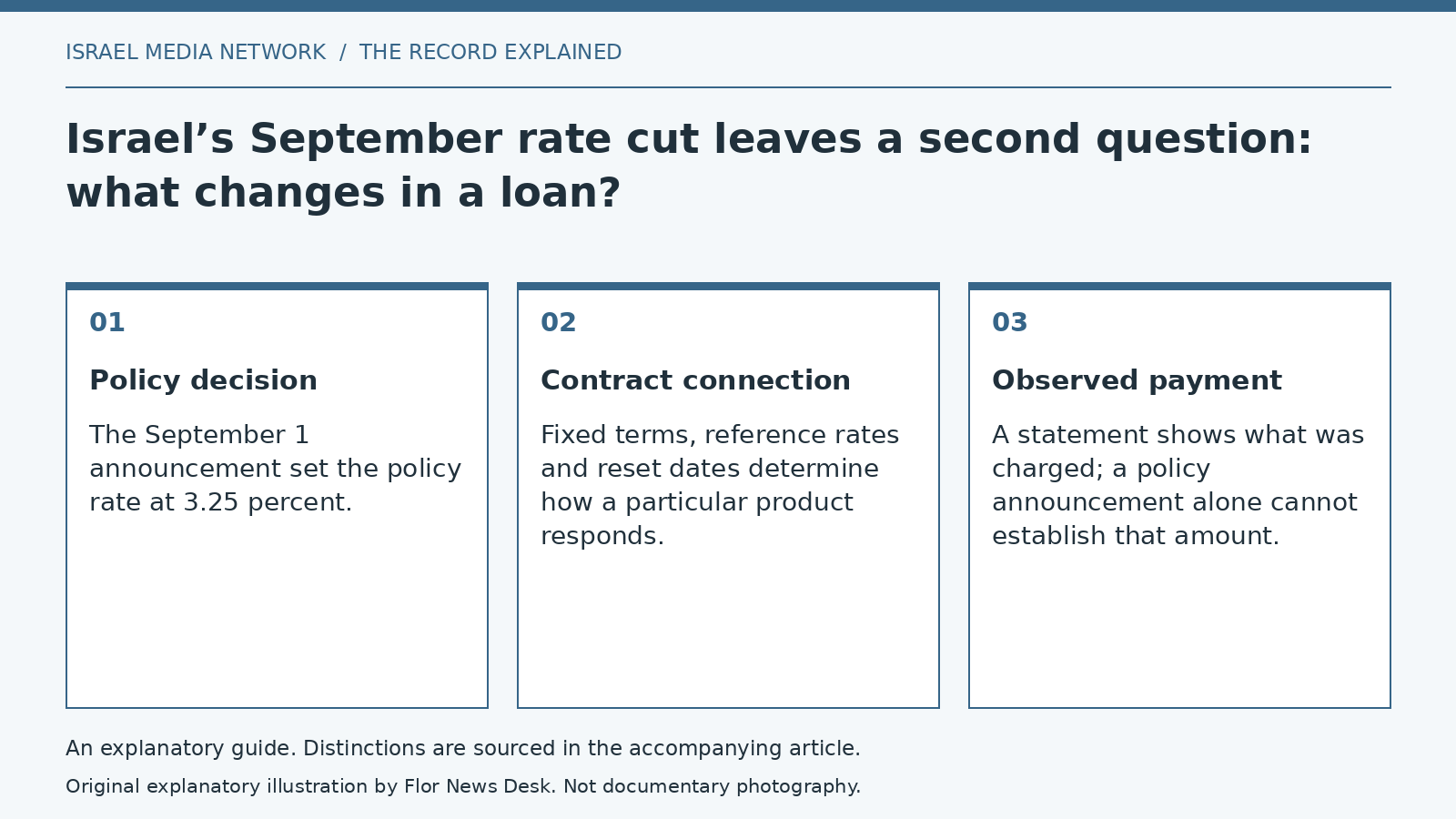

The Bank of Israel’s Monetary Committee lowered its policy rate to 3.25 percent on September 1, 2026. The decision announcement described moderating inflation while retaining concern about geopolitical uncertainty. It was a decision about the central bank’s policy instrument, not a new price schedule for every household or business loan.
That distinction matters when comparing the announcement with an account statement. A borrowing rate can be fixed, linked to a reference rate, or subject to a later reset. Without knowing the applicable arrangement, the policy figure alone cannot establish either a customer’s next payment or the date on which it changes.
The contract is the missing connection
Consider an illustrative loan with a fixed rate for its remaining term. A change in a separate reference rate would not change the fixed number simply through arithmetic. Now consider a hypothetical loan priced as a reference rate plus an unchanged margin. A change in that reference could change the quoted rate, but the reset date and payment calculation would still have to be identified. These are examples, not descriptions of particular bank products.
Even a known change in an annual rate is not the same quantity as a monthly instalment reduction. Principal outstanding, repayment structure and the length of the remaining loan affect that calculation. Multiplying a headline rate by an original loan balance would omit information about those other variables.
The central bank’s monetary-policy overview sets out the policy framework within which rate decisions are made. It provides institutional context rather than a determination of the obligations in an individual contract. Reading the overview and the dated decision together helps separate a policy objective from the mechanism through which a particular financial arrangement responds.
A decision is not a promised sequence
There is also a timing issue. The September 1 action establishes what the committee decided on that date. It does not guarantee the direction, size or timing of another decision. A borrower or saver could be affected differently by the same policy change; the announcement does not measure either person’s total financial position.
For interpreting the news, three records answer three different questions: the decision establishes the policy action, the product terms establish a contractual connection, and the subsequent statement shows what was actually charged. The first record cannot substitute for the other two. This analysis explains that distinction; it does not recommend a loan, a refinancing decision or an investment.