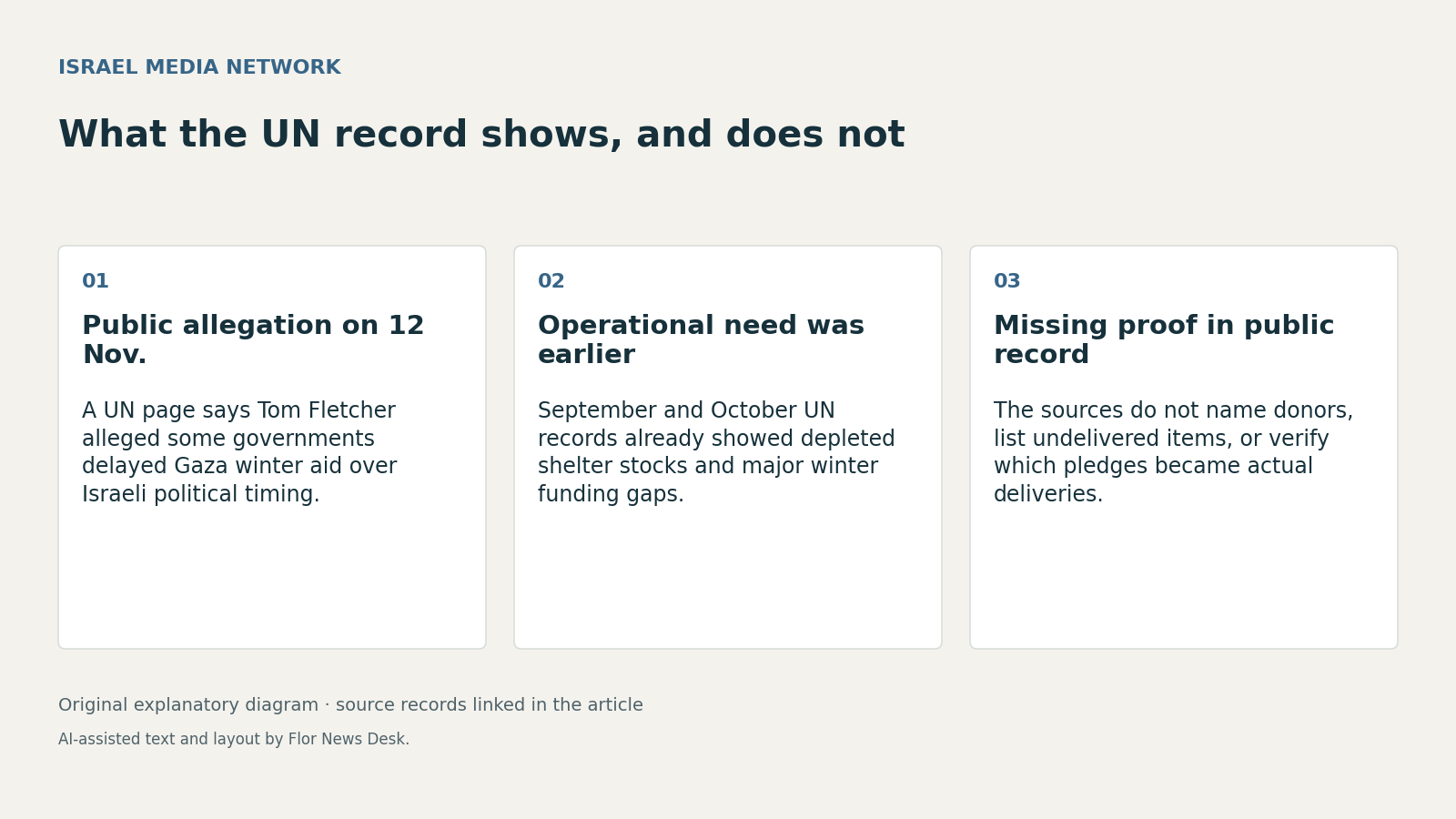
On 12 November, a UN Palestine Office page carried Emergency Relief Coordinator Tom Fletcher’s warning that some governments were still delaying winter support for Gaza, after earlier linking help first to Israeli elections and later to the formation of a government. That is a documented public escalation, because the UN record moved from describing shortages to alleging political delay by donors in the same breath as a winter emergency in Gaza. But the same page does not identify the governments involved, quantify the support in question or show what had actually arrived by that date. Those limits matter as much as the accusation itself. UN Palestine Office, 12 Nov. 2026
The operational case for urgency was already on the public record before Fletcher spoke. In its 24 September report to the Ad Hoc Liaison Committee, the United Nations Special Coordinator’s office said the 2026 Flash Appeal was only 40 percent funded, that shelter and non-food stocks were depleted, and that entry of critical humanitarian items continued to face constraints. The same report described mass displacement, extensive housing damage and a power system still not restored, with fuel and engine oil needing to enter at scale. Read together, those points do not prove donor delay in November, but they do show that winter planning was being discussed against a pre-existing shortage of money, shelter materials and access. UNSCO report, 24 Sept. 2026
An 19 October OCHA update narrowed that picture from general scarcity to a measurable winterization gap. OCHA said shelter partners still lacked 66 percent of the money they said they needed for cold and rainy season preparation, or US$186 million of US$283 million required. The same item said the wider 2026 Flash Appeal across the Occupied Palestinian Territory remained just over 40 percent funded, while other sectors were already cutting assistance because of shortages, including food support. That does not tell readers which donor, if any, failed to convert a pledge into a delivery. It does show that by mid-October the UN system was publicly describing winter needs as underfunded in concrete terms, not as a speculative future concern. OCHA update, 19 Oct. 2026
What Fletcher added on 12 November was a different kind of claim. He did not merely restate need. According to the UN Palestine Office account, he said support had been promised and then delayed while foreign ministers and partners pointed to political timing in Israel. He also listed the categories of aid the UN said it had already identified, from durable shelter and blankets to fuel, pumps and debris-removal equipment. The analytical shift is important: the public issue is no longer only whether Gaza needs winter supplies, but whether at least some promised support was being slowed for reasons outside the relief operation itself. UN Palestine Office, 12 Nov. 2026
Still, the public record in this source set stops short of proving the most contested points. It does not name the governments Fletcher had in mind. It does not separate cash pledges from in-kind goods, customs clearances or undelivered contracts. It does not establish whether delays reflected donor choice, access restrictions, procurement problems or several factors at once. A 5 November UNISPAL-hosted newsletter is even less useful for that question because it is explicitly a roundup of outside material provided without warranty, not primary verification of donor conduct. NGO Action News, 5 Nov. 2026
That leaves readers with a sharper but still incomplete accountability story. The UN has now publicly alleged delay by governments at the same time that its own September and October records show depleted stocks, funding gaps and winter exposure in Gaza. What the sources support is the gap between identified need and documented readiness. What they do not yet support is a named list of governments, amounts withheld or a verified delivery ledger by 14 November 2026. For an analysis piece, that distinction is the story: not that the allegation is proved, but that the UN has made it publicly while its own records show the consequences of any further delay would fall on a population already living in damaged shelter, restricted access and partial funding.