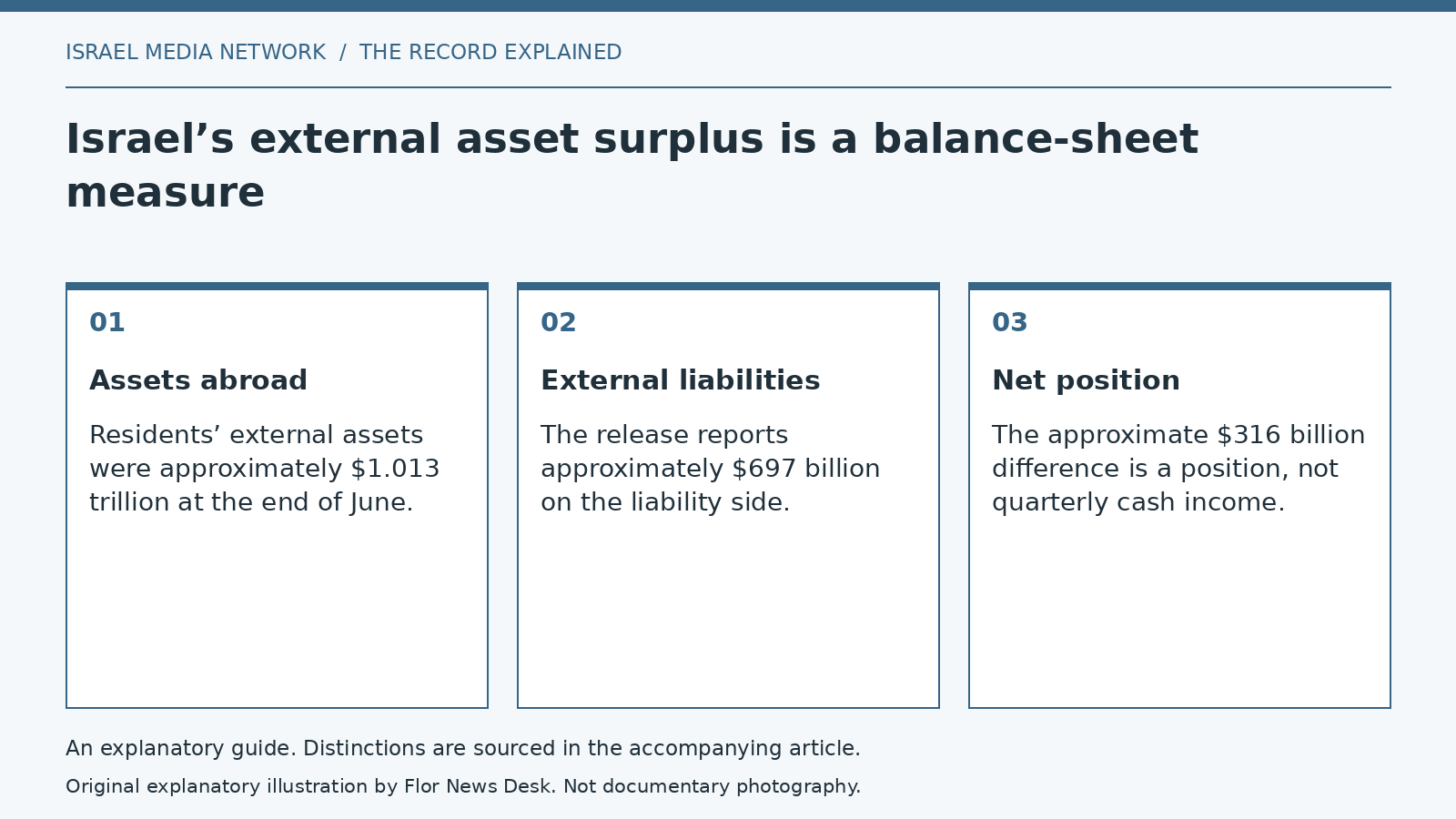

Israeli residents held approximately $1.013 trillion in assets abroad at the end of June 2026, while the economy’s external liabilities stood at about $697 billion. The Bank of Israel’s second-quarter investment-position release, published September 17, put the resulting asset surplus at around $316 billion.
The arithmetic is straightforward: subtracting the rounded liability balance from the rounded asset balance produces the reported surplus. Interpreting it requires more care. These are positions at a date. They do not describe a quarterly profit distributed to residents, a government budget surplus or the amount of cash entering the country.
The gross sides still matter
Imagine two simplified balance sheets. One contains assets of 20 and liabilities of 10; another contains assets of 110 and liabilities of 100. Both have a net position of 10, yet their gross exposures are very different. The example uses invented units to show why a net figure cannot describe the size or composition of both sides on its own.
Similarly, a national surplus does not imply that each resident has more foreign assets than liabilities. An aggregate could combine organizations with substantial overseas holdings and others with none. Moving from the economy-wide total to the position of a particular company or household would require its own records.
The bank attributes the quarter’s asset increase mainly to price gains and net investment in foreign securities. It separately discusses changes in external liabilities and direct investment. That presentation is another reason not to label the entire movement a single cash flow.
The official statistics directory places external positions among the bank’s broader datasets. A position statement and a record of transactions answer different questions, even when both concern cross-border finance. Their measurement periods and definitions need to be aligned before a comparison can support a conclusion.
A September release about June
The publication date and the reference date are three months apart. Calling the release a September balance would blur that distinction. Nor does the second-quarter position establish what happened to holdings after June.
A useful reading therefore keeps four labels in view: who holds the assets, who owes the liabilities, the date of the position and the reasons for its movement. The $316 billion surplus is meaningful within that accounting framework. It should not be turned into an unsupported claim about disposable national income or the finances of a typical resident.