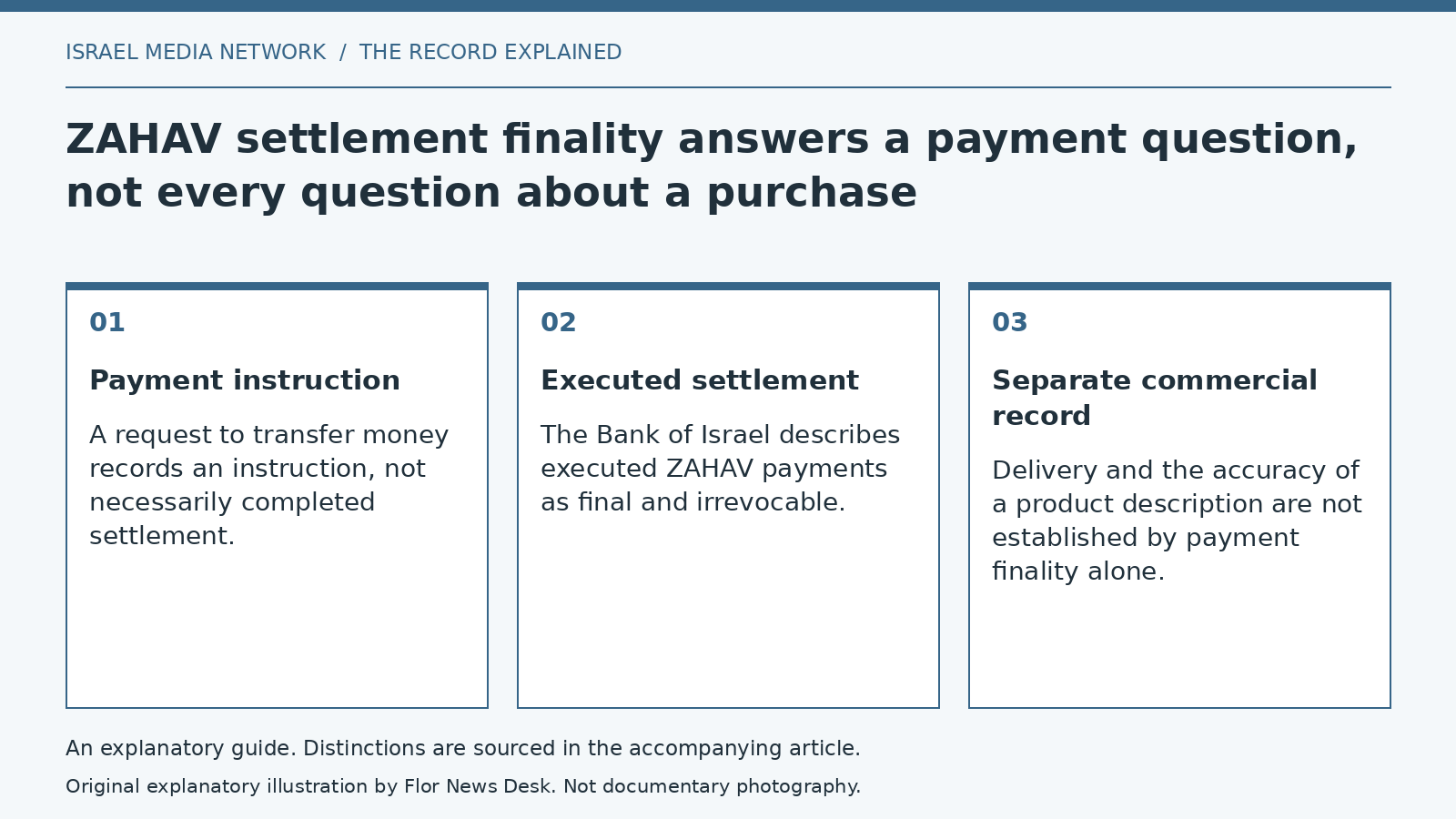

Israel’s ZAHAV system processes payments individually in real time, with settlement described by the Bank of Israel as final and irrevocable once a payment is executed. The bank’s system explanation makes finality a central distinction from payment arrangements that complete settlement later.
The boundary of that claim matters. Payment-system finality concerns the transfer being settled. It does not establish that goods were delivered, that a service met its description or that every statement made by the parties to a transaction was accurate.
An instruction is not a completion record
Consider a fictional business sending a payment instruction for an equipment purchase. The instruction shows what was requested. A settlement confirmation would establish a different stage. A delivery receipt would concern the equipment. Even when all three records belong to one transaction, none can simply stand in for the others.
The official explanation also connects execution with the availability of sufficient liquidity. Real-time processing therefore should not be paraphrased as every instruction completing regardless of conditions. The relevant observation is what happened to the particular payment, not only the general description of the system through which it was sent.
The Bank of Israel’s payment-systems overview places ZAHAV within a wider infrastructure. Different systems and instruments perform different functions. Naming a payment channel is useful context, but it is not a substitute for establishing the status of a transfer or the contractual facts behind it.
Finality and commercial evidence
In the hypothetical equipment sale, a final transfer could coexist with a later disagreement about the item delivered. That possibility does not contradict the description of settlement finality: the two records concern different events. This example is not a statement about legal remedies or a report of a real dispute.
The distinction is particularly important when interpreting a screenshot. A picture of an instruction and a verified record of completed settlement do not necessarily contain the same information. The description of a system cannot establish the authenticity or meaning of an image supplied in an unrelated exchange.
This is an explanation of the bank’s published system description, not an announcement of a September upgrade or a test of every participating institution. Reading the record precisely means identifying the event for which finality is claimed. A payment system can settle a transfer; the surrounding purchase still has its own evidence of agreement, performance and delivery.