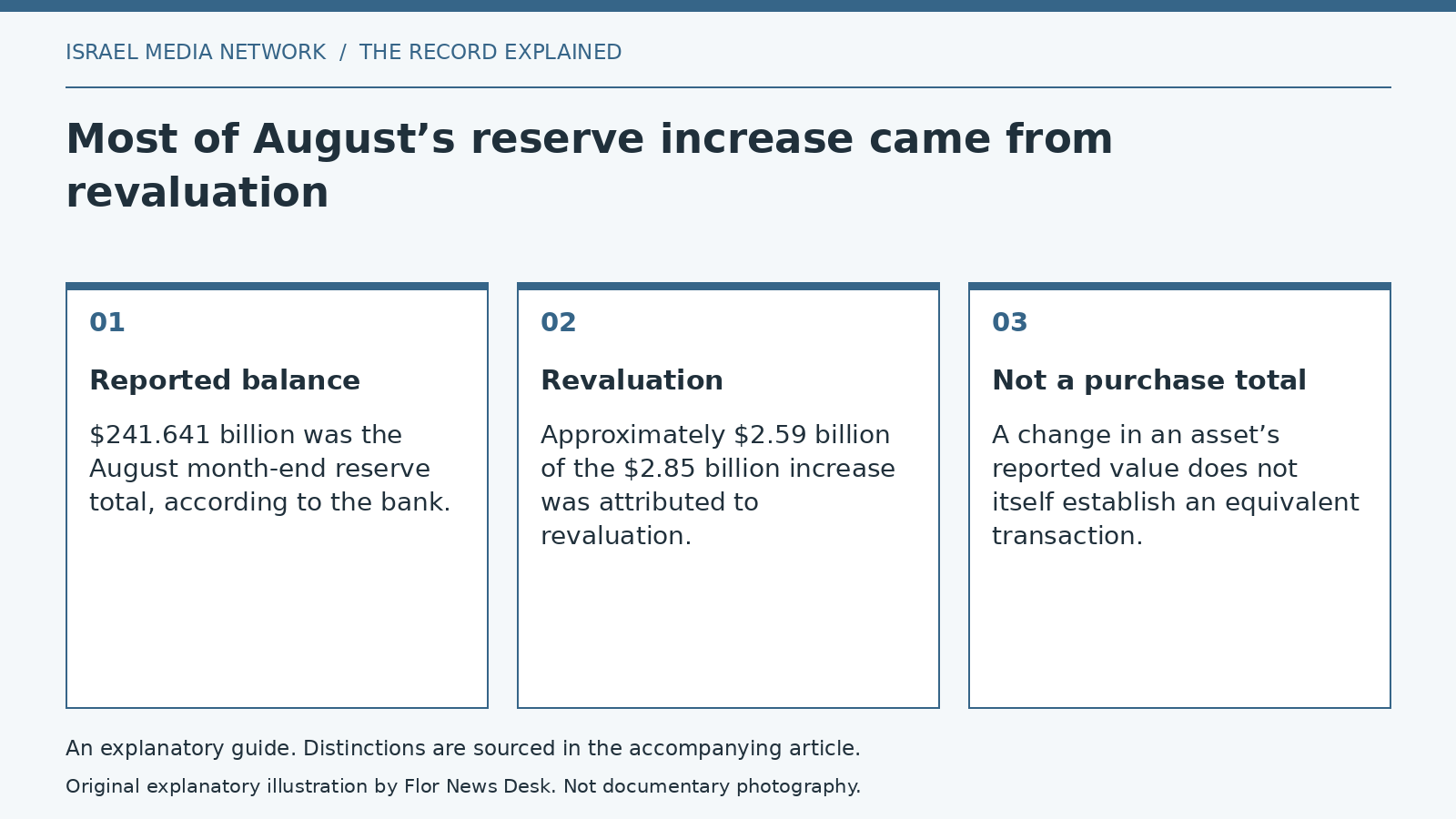
Israel’s foreign-exchange reserves reached $241.641 billion at the end of August 2026, according to the Bank of Israel’s September 7 release. The reported monthly increase was $2.85 billion. Of that movement, approximately $2.59 billion was attributed to revaluation, making valuation changes central to reading the result.
Dividing those rounded amounts puts revaluation at about 91 percent of the reported increase. That calculation describes the relative size of one component. It does not establish that the bank bought an equivalent amount of currency, received that amount as new income, or added it to a government spending account.
A balance can change without an equivalent purchase
A simplified example illustrates the accounting distinction. Suppose an institution holds an asset worth 100 units at the beginning of a period. If its quoted value rises to 105 while the holding is unchanged, the reported asset value rises by five. No additional purchase is needed to produce that particular movement. Actual reserve portfolios are more complex; this example is not a reconstruction of the bank’s holdings.
The release also identifies government foreign-exchange activity as a contributor. Its rounded explanatory amounts should not be treated as an exhaustive transaction ledger. Small residual differences do not, by themselves, establish a missing transaction or an error. A reconciliation would need the complete components and their rounding conventions.
The bank’s reserve-management information supplies background on the function of these assets. It is important not to confuse that reserve portfolio with the entire economy’s foreign assets, or with the cash available to any individual household. The holder, purpose and accounting boundary differ.
Keep the month-end label attached
The balance is dated to the end of August. Publication on September 7 made that observation available; it did not convert it into a September month-end result. Later market movements could change valuations again, but the August release does not report those later outcomes.
The distinction is useful beyond this single release. Before describing an increase as a flow of money, a reader needs to establish whether it reflects transactions, prices, exchange-rate translation or another accounting change. The reserve headline answers how large the reported balance was. The accompanying explanation begins to answer why it moved. Those questions belong together, but their answers are not the same.